
What the Independent Bike Dealer can learn from Domino's
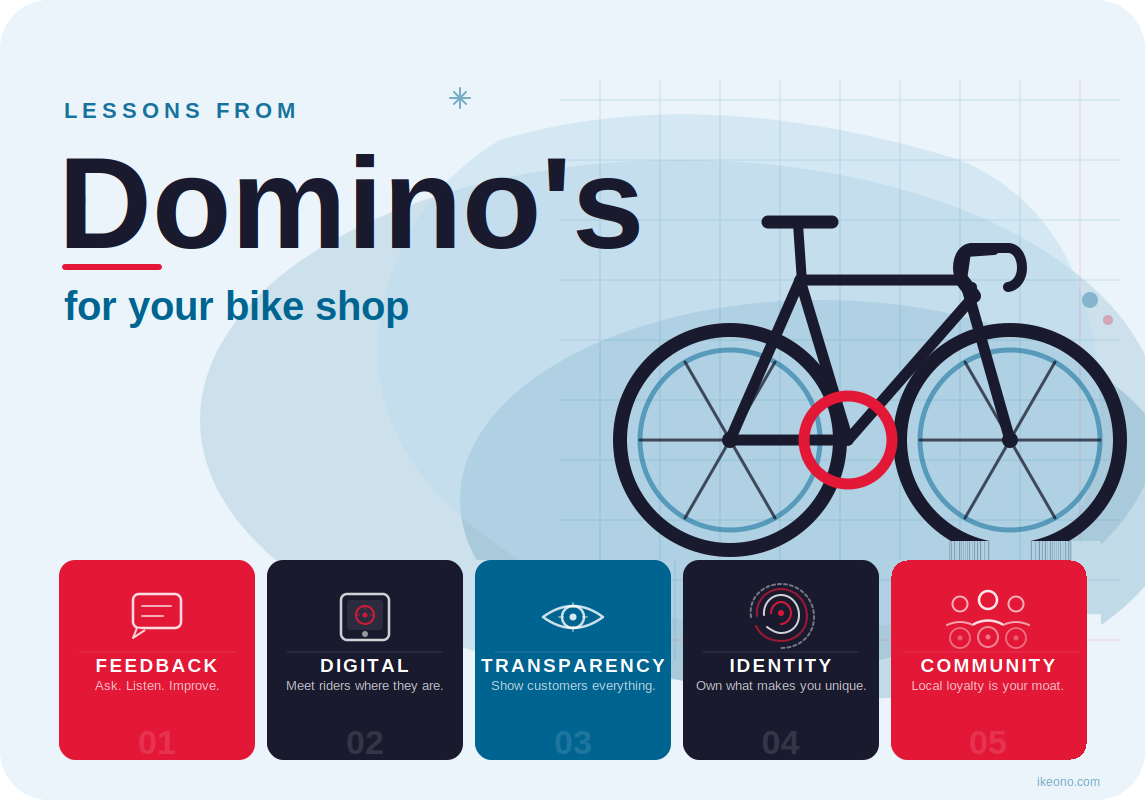
In 2010, Domino’s did something almost no major brand has ever done: they admitted their product was terrible — and turned it into their greatest asset. Independent bike dealers facing a brutal post-pandemic correction have more in common with that moment than you might think.
The numbers for the industry are uncomfortable. 104 bicycle brands exited the US market in 2025 alone. Inventory gluts have forced relentless discounting that erodes your margins. Online-only brands and big-box retailers are undercutting on price. And a 2024 survey found that 62% of riders can’t explain the difference between the top ten global bike brands — which means customers often can’t articulate why they should choose your shop over clicking “add to cart.”
Sound familiar? In 2008, Domino’s stock cratered to $2.61 a share. Their own focus groups showed customers calling their pizza “cardboard.” No brand loyalty. No love. Just a commodity product that had forgotten what made it worth choosing.
What happened next is one of the most studied brand comebacks in business history. By 2021, that stock had climbed above $530. The playbook wasn’t complicated. It was honest — and it’s one any independent bike shop can run.
5 takeaways for independent bike dealers
Takeaway 01
Stop pretending the customer experience is fine. Name what isn’t.
Domino’sFor your shopDomino’s didn’t quietly tweak their recipe and hope no one noticed. They put their worst customer reviews on national TV. The underlying message was powerful: unlike the banks and the car companies, we listened. Sales rebounded 16.5% almost immediately.
For IBDs, this means being honest about the friction points that drive customers online: inconsistent wait times, intimidating shop floors, staff that talks over beginners, fitting processes that feel like a shakedown. You already know what the weak spots are. Your Google reviews probably name them.
Consider making your shop’s commitment to service visible and specific — not “we love bikes” boilerplate, but real standards. What does a visit to your shop guarantee? That’s worth putting on your wall and your website.
Takeaway 02
Invest in what only you can offer. Service is your new product.
Domino’sFor your shopDomino’s spent 18 months rebuilding their recipe from scratch before launching a single ad. They didn’t just run a better campaign — they made a genuinely better pizza. The marketing only worked because the product backed it up.
For IBDs, the product is increasingly service. Industry data shows that maintenance and repair volume rose 7% in 2024 as cyclists opted for repairs over new purchases. That’s not a consolation prize — it’s a signal about where loyalty lives. The customer who trusts you with their bike is worth ten impulse buyers.
Domino’s parallel
Rebuilt core product before marketing. Tested it rigorously. Only then made promises in public.IBD opportunity
Build service tiers, annual maintenance plans, guaranteed turnaround times. Make your expertise a product people pay for and return for.A shop with a waiting list for service is far more defensible than a shop competing on accessory margins.
Takeaway 03
Use technology to deepen the relationship, not just process transactions.
Domino’sFor your shopDomino’s built the Pizza Tracker in 2008 — real-time updates that made customers feel informed and respected. They set a goal to grow digital orders to 50% of transactions by 2015. They hit it, and digital revenue grew to over 60% of their business. Technology wasn’t a feature. It was the relationship.
Most IBDs are still running customer relationships out of a paper log or a basic POS. That means no service history follow-ups, no reminders when a customer’s bike is due for a tune, no record of what they bought last time and what they might need next.
Simple CRM tools, automated service reminders, and a clean scheduling system aren’t big-box retail moves — they’re the baseline expectation for any business that wants repeat customers. The IBDs pulling ahead are the ones treating their customer list as their most valuable asset.
Takeaway 04
Grow your local pie. The next generation of riders is right outside your door.
Domino’sFor your shopOne underrated part of the Domino’s turnaround is that they didn’t just win back lapsed customers — they expanded who pizza delivery was for, using digital convenience to reach entirely new demographics and occasions.
IBDs have untapped markets in plain sight. Women are the fastest-growing cycling demographic, with a 9% rise in activity in 2024 — yet most shops still design their floor plan, staffing, and product mix around an assumed male customer. Kids’ cycling participation is down a third from pre-COVID levels, which is an existential pipeline problem the industry has largely ignored.
Underserved segment
Women cyclists — fastest-growing group, often underserved by shop culture, fit expertise, and product selection.Pipeline opportunity
Youth programs, learn-to-ride clinics, and school partnerships are community investments that compound into customers.The IBD that hosts a women’s Tuesday night ride, runs a summer kids’ clinic, and partners with a local school isn’t just doing good community work — they’re building the customer base that sustains the shop for the next decade.
Takeaway 05
Commit to your identity. Don’t let a bad quarter make you generic.
Domino’sFor your shopRussell Weiner, the marketing lead behind the Domino’s turnaround, was blunt about the failure mode he saw in struggling brands: “Decide on your strategy, research it, and stick to the plan.”
The pressure of slow sales pushes IBDs toward sameness — stocking whatever moves, discounting whatever doesn’t, becoming a generalist to survive. That’s exactly the wrong move. The shops that thrive through market corrections are the ones with a clear identity: the gravel specialists, the family shop, the commuter hub, the MTB community anchor.
Domino’s biggest competitor, Weiner told MBA students, isn’t Pizza Hut. It’s who they were yesterday. For your shop, the question isn’t how to beat the big-box store — it’s whether you’re becoming the best version of what only you can be.
The bottom line
Domino’s turnaround wasn’t magic. It was a company willing to say, out loud, that they had failed their customers — and then doing the unglamorous, expensive, operationally complex work of actually fixing it. They didn’t out-spend the competition. They out-cared them.
Independent bike dealers have something Domino’s spent years trying to manufacture: genuine human relationships, deep local roots, and expertise that can’t be replicated by an algorithm. The market isn’t broken — it’s bloated, undifferentiated, and desperate for shops willing to lead with honesty and follow through with substance.
The pizza was always worth eating. Someone just had to be brave enough to admit it wasn’t — and then do the work to make it worth coming back for. Your shop can do the same thing.